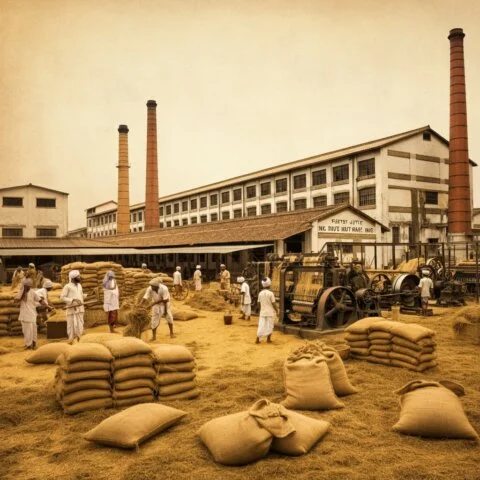
Picture this: a quiet stretch of riverbank near Kolkata in 1855, where one bold experiment would change the course of Indian industry forever. The first jute mill in India wasn’t just a factory. It was the spark that ignited an entire economic powerhouse! Known as the Acland Mill, this pioneering venture launched the mechanized jute industry in India and set the stage for a story that still matters today.
So, why does a 170-year-old mill deserve your attention? Because its history teaches us how vision, timing, and natural resources can transform a region, and how a humble golden fiber became one of India’s most valuable exports. Let’s dive into the fascinating tale behind it all.
The Historical Background Before the First Jute Mill in India
Long before machines hummed along the Hooghly, jute was already woven into Bengali life. People used this sturdy fiber for ropes, sacks, and rough cloth. However, early jute manufacturing in India was slow, inefficient, and low in quality. Everything was done by hand, which limited how much the region could produce.
Then global events changed the game.
The Crimean War and the Dundee Connection
Here’s where things get interesting. During the Crimean War, the supply of flax and hemp from the Russian Empire to Britain suddenly dried up. British manufacturers, especially those in Dundee, Scotland, needed a new raw material fast. Bengal, with its abundant jute fields, stepped right in.
As a result, Bengal began exporting huge quantities of raw jute to feed Dundee’s textile mills. This trade link proved permanent, and it created the perfect conditions for someone to ask a clever question: why ship raw jute all the way to Scotland when you could spin it right here in India?
That question would soon launch the history of jute manufacturing in the country.
The Founding Figures Behind the Acland Mill
Every great story needs its key players, and this one features a fascinating duo.
George Acland: The British Entrepreneur
George Acland was an English entrepreneur from Devonshire with quite the colorful résumé. He had owned coffee plantations in Ceylon and served as a marine in the East India Company’s Marine. After facing losses in earlier ventures, Acland was hunting for a fresh opportunity.
Originally, he planned to grow rhea grass as a substitute for flax and hemp. However, a machine manufacturer named John Kerr offered him better advice: manufacture jute products in Bengal instead. Acland listened, and that decision made history!
Babu Bysumber Sen: The Bengali Financier
Acland didn’t do it alone. He partnered with a Bengali financier named Babu Bysumber Sen, who provided crucial financial backing. Together with a jute overseer brought in from Dundee, they installed the first jute spinning machinery in India. This partnership between British enterprise and Bengali capital perfectly captures the collaborative spirit that built early industry in the region.
Where the First Jute Mill in India Was Located
Location matters, and the founders chose wisely. They established the mill in Rishra, a town on the banks of the Hooghly river in present-day West Bengal, in 1855.
Why Rishra? Consider these advantages:
- River access: The Hooghly offered easy transport for raw materials and finished goods.
- Proximity to Calcutta: The bustling port city sat nearby, connecting the mill to global trade routes.
- Abundant jute supply: Bengal’s fertile fields produced plenty of raw fiber close by.
Here’s a delightful historical detail: the mill was built on land that once formed part of the Garden House property owned by Warren Hastings, the first Governor-General of India. Imagine the layers of history packed into that single plot!
Inside the Operations of the First Jute Mill in India
So, what actually happened once the machines started running? Quite a lot, actually.
The Acland Mill quickly proved its worth. In its first two years, it produced an impressive 8 tons of jute yarn per day, which workers then sold to local weavers. The mill ran under the management of Charles Smith, an experienced jute overseer from Dundee who brought valuable technical know-how.
Then, in 1857, the operation expanded. The mill added handweaving of coarse gunny cloth using a small number of frame hand looms. This move broadened its product range and demonstrated jute’s commercial versatility.
Around this same time, Acland transformed the business into a limited liability company called Rishra Twine and Yarn Mills Co. Ltd. During the Indian Rebellion of 1857, he even hired seamen from the Sailors’ Home in Calcutta to guard the property. Talk about dramatic times for a young factory!
The Post-Fire Legacy and Reestablishments
Now, here’s a twist worthy of any great story. In 1858, disaster struck: the mill burned down. But this setback wasn’t the end. Far from it!
Let’s trace the remarkable journey of reinvention:
- 1862 – Ischera Yarn Mill: Acland rebuilt and relaunched the operation under a new name.
- 1868 – Wound up and auctioned: The mill closed temporarily and changed hands.
- 1872 – Calcutta Jute Mills Co. Ltd.: New owners restarted it, and the timing proved golden. British demand surged during the American Civil War, and the mill thrived by supplying jute bags to Bombay (now Mumbai).
- 1877 onward – Wellington Jute Mills: After more ownership changes, the Champdany Jute Company (James Finlay & Co.) purchased it in 1880 and renamed it.
This cycle of destruction and rebirth shows just how resilient and profitable the jute industry in India had become. Each setback gave way to renewed success!
The Long-Term Impact on the Jute Industry in India
Here’s where we see the true significance of that first jute mill in India. Its modest success didn’t stay modest for long. Instead, it inspired a wave of new ventures.
Consider the ripple effects:
- More mills sprang up: A mill established by the Borneo Company in 1859 enjoyed major success in the late 1860s and early 1870s. Soon, dozens of mills lined the banks of the Hooghly.
- Massive employment: At its peak, the industry employed hundreds of thousands of workers across mills and factories. Today, it still provides jobs for over two lakh industrial workers and supports around forty lakh farming families.
- Economic engine: The jute industry in India contributes between INR 1,000 and INR 2,000 crore in export earnings annually. Now that’s an impressive return on one factory’s gamble!
Most jute mills remain concentrated in West Bengal, mainly along a narrow belt beside the Hooghly river. There are roughly 70 mills in the country, with about 60 located in West Bengal alone. The Central Research Institute for Jute and Allied Fibers also calls this region home.
After the Partition of 1947, three-fourths of the jute-producing area went to East Pakistan (now Bangladesh). Even so, India remains the largest producer of raw jute and jute goods, standing second only to Bangladesh as an exporter.
Why the First Jute Mill in India Still Matters Today
You might wonder whether a 19th-century mill holds any relevance now. The answer is a resounding yes!
Jute is enjoying a genuine revival, and for good reason. As a natural, biodegradable, and CO2-neutral fiber, it fits perfectly into our growing demand for sustainable materials. Here’s why the “golden fiber” is winning fans again:
- Eco-friendly by nature: Jute needs very little maintenance to grow and decomposes naturally.
- Incredibly versatile: From twine, rope, and gunny sacks to carpets, curtains, and even non-woven composites for furniture and automobiles, jute does it all.
- Plastic alternative: After plastic bans gained momentum, many organizations switched to jute packaging.
The journey that began at the Acland Mill continues to shape lives, livelihoods, and our planet’s future. Not bad for a single factory on a riverbank!
Key Takeaways
Let’s recap the essentials of this remarkable story:
- The first jute mill in India, the Acland Mill, was established in 1855 at Rishra on the Hooghly river.
- George Acland founded it alongside Bengali financier Babu Bysumber Sen.
- It produced 8 tons of yarn daily and survived fire, closures, and multiple name changes.
- The mill launched an industry that now contributes thousands of crores to India’s economy.
- Jute’s eco-friendly qualities make this history surprisingly relevant today.
The next time you spot a humble jute sack or a stylish jute rug, remember the bold experiment that started it all. History, it turns out, can be woven from the simplest of fibers!
FAQ: The First Jute Mill in India
1. Which was the first jute mill in India?
The first jute mill in India was the Acland Mill, established at Rishra in West Bengal in 1855. It is considered the foundation of India’s organized jute manufacturing industry.
2. Where was the first jute mill established in India?
The first jute mill was established at Rishra, a town located on the banks of the Hooghly River in present-day West Bengal.
3. Who founded the first jute mill in India?
The first jute mill was founded by George Acland, a British entrepreneur who played a key role in introducing mechanized jute manufacturing to India.
4. Why was Rishra chosen as the location for the first jute mill?
Rishra was selected because it was close to jute-growing areas, had access to river transportation, offered a readily available workforce, and was near the port of Kolkata for exports.
5. What was the significance of the first jute mill in India?
The establishment of the first jute mill marked the beginning of the Indian jute industry. It contributed to industrial growth in Bengal and helped India become one of the world’s leading producers of jute goods.

Meena Ansari is the co-founder and business partner at M/s Tex Aux Chemicals. A passionate writer at heart, she brings a deep curiosity and love for learning to every aspect of the textile industry. With a keen interest in exploring innovations and sharing insights, Meena combines her entrepreneurial experience with a flair for storytelling to educate and inspire readers across the textile community.
- Meena Ansari
- Meena Ansari
- Meena Ansari
- Meena Ansari
- Meena Ansari
- Meena Ansari
- Meena Ansari
- Meena Ansari
- Meena Ansari
- Meena Ansari
- Meena Ansari
- Meena Ansari
- Meena Ansari
- Meena Ansari
- Meena Ansari
- Meena Ansari