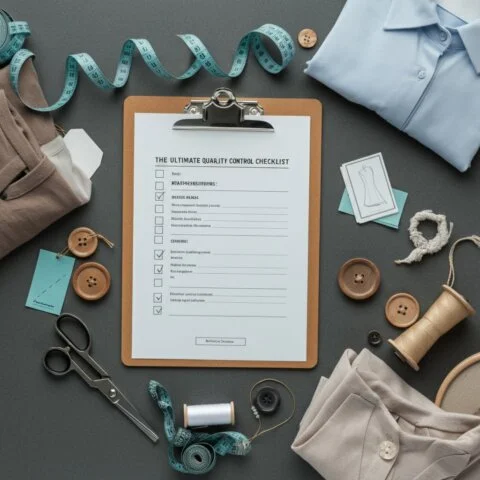
Picture this: your shipment finally arrives, you open the first carton, and the colors don’t match your approved sample. Frustrating, right? I’ve seen it happen, and it almost always traces back to one thing—a missing or weak garment quality control checklist.
Here’s the good news. When you inspect at the right moments with the right checklist, you catch problems early, slash returns, and protect your brand reputation. So let’s walk through a complete, three-stage approach that most competitors skip over. Along the way, you’ll get a practical apparel inspection checklist, a clear defect classification table, and answers to the questions buyers ask most.
Ready? Let’s dive in!
Why a Garment Quality Control Checklist Matters
The apparel industry has one of the highest defect rates in manufacturing. After all, fabric quality drifts between production runs, stitching varies from line to line, and even the same factory can deliver inconsistent results. Fortunately, a structured garment quality control checklist removes the guesswork.
In short, a strong checklist gives you three big wins:
- Consistency: Every inspector evaluates each garment the same way, no matter who’s on the floor.
- Early defect detection: You spot trouble before it multiplies across thousands of units.
- A clear record: You document exactly what was verified, which makes supplier conversations far easier.
Now, here’s where most guides fall short. They hand you a single checklist for finished goods only. However, true quality control actually happens across three stages. So let me show you each one.
Stage 1: Pre-Production Checks (Before the First Stitch)
Quality starts long before sewing begins. During pre-production, you confirm that materials and specifications are ready, so the factory doesn’t have to guess.
Follow these steps:
- Review the tech pack. First, confirm measurements, construction details, and packaging instructions are complete and crystal clear.
- Approve raw materials. Next, check fabric, trims, and accessories against your approved samples.
- Run fabric quality control. Then inspect incoming fabric using the 4-point system, which assigns penalty points by defect size (1 point up to 3 inches, up to 4 points for defects over 9 inches). Fabric usually passes below 40 points per 100 linear yards.
- Verify GSM. After that, use a GSM cutter and scale to confirm fabric weight matches the spec. For example, a lightweight tee runs 120–160 GSM, while a heavyweight hoodie hits 300–400 GSM.
- Confirm color standards. Finally, match lab dips and approved swatches under a D65 light box.
Key takeaway: Catching fabric defects before cutting saves you from sewing flaws into thousands of finished garments. Because this is the cheapest stage to fix problems, don’t skip it!
Stage 2: During-Production Inspection (DUPRO)
Once production reaches 10–30% completion, it’s time for a during-production inspection, or DUPRO. Above all, this stage catches issues while there’s still time to correct the rest of the run.
Here’s what to focus on:
- First-output checks: Inspect the earliest finished pieces against the approved sample.
- Stitching and seams: Look for skipped stitches, broken threads, puckering, and uneven seam allowances.
- Measurements: Lay garments flat and measure critical dimensions across multiple sizes.
- Consistency across lines: Compare output from different production lines to spot drift early.
Key takeaway: A DUPRO inspection is your safety net. For instance, fixing a recurring stitching error at 20% completion is far cheaper than discovering it in the final carton!
Stage 3: Final Random Inspection (FRI)
The final random inspection (FRI) happens when production is at least 80% complete and 100% packed. At this point, inspectors pull a random sample based on AQL standards to represent the whole lot. As a result, this is the textile inspection checklist most buyers rely on before approving shipment.
The Complete Apparel Inspection Checklist
Use this formatted checklist during your FRI to cover every critical checkpoint.
Fabric & GSM
- Fabric composition matches specification
- GSM within tolerance
- No holes, snags, pilling, or pulls
- No stains, oil marks, or dirt
- Consistent weave or knit structure
Color Fastness
- Color matches approved standard under D65 light box
- No shade variation between pieces
- Dry crock fastness acceptable (Grade 3–4 minimum)
- Wet crock fastness acceptable (Grade 3 minimum)
Stitching & Seams
- Correct stitch type and density (SPI/SPC)
- No skipped or broken stitches
- No puckering at seams
- Thread ends trimmed to ≤1/2 inch
- Bartacking secure at stress points
Measurements & Sizing
- All critical measurements within tolerance
- Multiple sizes verified per size chart
- Left/right symmetry balanced
- Front vs. back length uniform
Trims & Accessories
- Buttons attached, aligned, and pull-strength tested (≈3 lb / 1.4 kg)
- Zippers operate smoothly without catching
- Snaps and rivets function and hold firmly
- Elastic recovery acceptable
Labeling Compliance
- Care label present with correct wash symbols
- Fiber content and country of origin accurate
- Size and brand labels correctly positioned
- Barcode scans correctly
Packaging
- Polybag correct thickness (≥0.025mm) and size
- Suffocation warning present (if required)
- Folding method matches specification
- Carton dimensions, weight, and shipping marks correct
- Packing ratio matches the packing list
Key takeaway: Bookmark this apparel inspection checklist and share it with your inspection provider alongside your specs and approved samples. Ultimately, consistency here is everything!
Understanding Garment Defect Classification and AQL Standards
Not every flaw carries the same weight. That’s why garment defect classification uses three tiers tied to AQL standards. In simple terms, AQL—Acceptable Quality Limit—defines how many defects a lot can contain before you reject it.
Defect Type | AQL Level | Examples |
|---|---|---|
Critical | AQL 0.0 | Needle or metal contamination, sharp edges, choking hazards on kids’ wear, banned chemicals, flammability failures |
Major | AQL 2.5 | Measurements out of tolerance, wrong size label, broken zippers, open seams, large fabric holes, significant color deviation |
Minor | AQL 4.0 | Loose threads, slight shade variation, minor pilling, removable stains, slightly crooked labels |
Key takeaway: Critical defects mean zero tolerance—any occurrence fails the lot. Therefore, define your AQL levels in the purchase order so your supplier and inspector work from the same playbook.
Tips for Stronger Quality Control
Want to level up? Try these proven habits:
- Define tolerances upfront. For example, a common standard is ±1/2 inch for adult garments and ±1/4 inch for children’s wear.
- Always run needle detection. This catches broken needles and metal fragments—critical for kids’ and intimate apparel.
- Inspect fabric and finished goods. Together, this dual approach gives high-value orders the strongest protection.
- Go digital. In addition, digital checklists streamline documentation and deliver real-time data on your quality metrics.
Bring It All Together
A great garment quality control checklist isn’t a single document—it’s a three-stage system. In other words, you confirm materials before production, monitor quality during the run, and verify the finished lot against AQL standards before shipment. Then, layer in solid garment defect classification, and you’ll ship with confidence every single time.
So grab this checklist, share it with your team, and make your next inspection your smoothest yet. Your future self—and your customers—will thank you!
Frequently Asked Questions
What is a garment quality control checklist?
A garment quality control checklist is a standardized document used during production to ensure apparel meets specific quality standards. It details requirements for materials, stitching, measurements, and packaging. This tool helps inspectors systematically identify defects, ensuring consistency and protecting brand integrity before products reach the customer.
How can quality control reduce production costs?
A strong quality control process catches defects early, reducing material waste and the need for expensive rework. By preventing faulty products from being shipped, it lowers customer return rates and associated costs. This proactive approach minimizes financial losses and improves overall efficiency, directly impacting your bottom line.
What is AQL in garment quality control?
AQL stands for "Acceptable Quality Limit." It is a statistical sampling method used to determine the maximum number of defective units acceptable in a production batch. Rather than inspecting every single item, inspectors check a random sample, saving time while still maintaining quality standards across large orders.
Why are in-line inspections important during production?
In-line inspections allow you to identify and correct quality issues in real-time as garments are being made. This prevents an entire batch from being produced with the same error, saving significant time and resources. It's a crucial step for maintaining consistency and efficiency on the production line.

Meena Ansari is the co-founder and business partner at M/s Tex Aux Chemicals. A passionate writer at heart, she brings a deep curiosity and love for learning to every aspect of the textile industry. With a keen interest in exploring innovations and sharing insights, Meena combines her entrepreneurial experience with a flair for storytelling to educate and inspire readers across the textile community.
- Meena Ansari
- Meena Ansari
- Meena Ansari
- Meena Ansari
- Meena Ansari
- Meena Ansari
- Meena Ansari
- Meena Ansari
- Meena Ansari
- Meena Ansari
- Meena Ansari
- Meena Ansari
- Meena Ansari
- Meena Ansari
- Meena Ansari