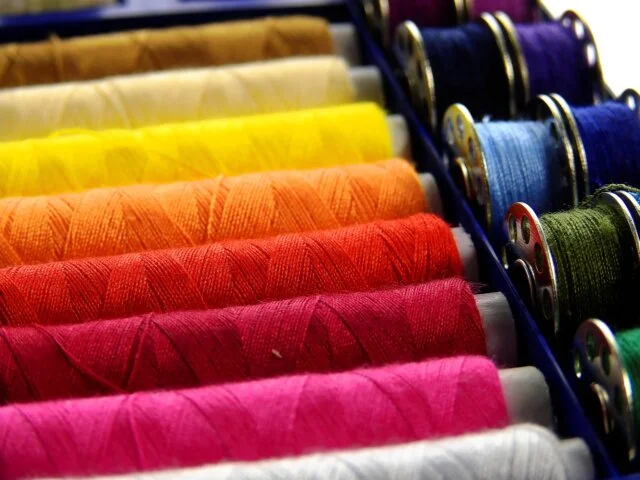
The distinction between these two textile strands lies in their construction, finishing, and intended application within manufacturing. Both qualify as continuous strands assembled from textile fibers; however, manufacturers engineer yarn for fabric formation through weaving and knitting, whereas they design thread for stitching, sewing, and embroidery operations. Although the garment industry frequently uses the two terms interchangeably, they represent distinct product categories with separate performance specifications.
This guide examines the thread vs yarn distinction in detail, covering material composition, production processes, characteristic properties, and typical use cases for each.
Thread vs Yarn: The Quick Answer
Yarn is a continuous strand of twisted fibers that produces fabrics through weaving, knitting, and crocheting. In contrast, thread is a finer, higher-twist strand engineered from yarn through additional finishing treatments, designed specifically for sewing and stitching. The primary distinction is purpose: yarn builds fabric, while thread joins fabric. Furthermore, thread carries higher tensile strength, smoother surface lubrication, and greater abrasion resistance than standard yarn.
What Is Yarn?
Yarn is a continuous strand of fibers twisted together to form a long, flexible structure suitable for fabric manufacturing. Functionally, it serves as the foundational input for woven, knitted, and crocheted textiles.
Manufacturers may produce yarn from natural fibers, synthetic fibers, or fiber blends. Moreover, the twisting of these fibers provides the strength and cohesion required for downstream textile processing.
Types of Yarn
- Spun yarn — Produced by twisting staple fibers together; cotton yarn is a common example.
- Filament yarn — Composed of continuous filaments such as polyester or nylon filament.
- Blended yarn — Combines two or more fiber types to improve performance and comfort.
- Fancy yarn — Incorporates decorative effects such as loops, slubs, or knots for aesthetic purposes.
What Is Thread?
Thread is a fine strand engineered specifically for sewing, stitching, and embroidery applications. Typically, manufacturers produce it from base yarns that undergo additional finishing treatments to improve strength, smoothness, and durability.
Unlike yarn, thread withstands friction, needle heat, mechanical tension, and repeated movement during high-speed sewing operations.
Types of Thread
- Sewing thread — Applied in garment stitching and industrial sewing operations.
- Embroidery thread — Designed for decorative work, featuring high luster and surface smoothness.
- Quilting thread — Manufactured for quilting applications with enhanced durability.
- Industrial thread — Used in heavy-duty products such as footwear, upholstery, luggage, and automotive textiles.
Difference Between Thread and Yarn: Comparison Table
The following table summarizes the core points of the yarn and thread comparison across construction, finishing, and function.
Basis | Yarn | Thread |
|---|---|---|
Definition | Continuous strand used for fabric production | Fine strand used for sewing and stitching |
Main Purpose | Weaving and knitting | Sewing and embroidery |
Strength | Moderate | High |
Finishing | Minimal finishing | Specialized finishing applied |
Surface | Relatively soft | Smooth and lubricated |
Construction | Single or multiple plies | Usually multi-ply |
Twist Level | Lower twist | Higher twist |
Durability | Designed for fabric formation | Designed for seam durability |
Usage | Fabric manufacturing | Garment assembly |
Resistance to Friction | Lower | Higher |
Thread and yarn share a common pool of textile fibers, though each fiber contributes distinct performance characteristics. Consequently, material selection directly determines strength, comfort, dyeability, and end-use suitability. |
- Cotton — Widely used in both yarns and sewing threads due to softness, comfort, and moisture absorbency.
- Polyester — Selected for high tensile strength, durability, and wrinkle resistance.
- Nylon — Valued for elasticity and superior abrasion resistance.
- Silk — Applied in luxury textiles and decorative embroidery for luster and fineness.
- Rayon — Provides softness and excellent dyeability across embroidery and apparel applications.
Production Processes: How Yarn and Thread Are Made
The manufacturing distinction is central to the thread vs yarn comparison. Specifically, yarn production establishes the base strand, while thread production adds engineering steps that elevate performance.
Yarn Manufacturing Process
Yarn production depends on the fiber type and the selected spinning method. Generally, the standard sequence includes:
- Fiber preparation — Fibers are cleaned and aligned.
- Carding and combing — Fibers are separated and parallelized.
- Drawing — Fibers are blended and elongated for uniformity.
- Spinning — Fibers are twisted together to form yarn.
- Winding — The finished yarn is wound onto packages for further processing.
Thread Manufacturing Process
Thread production incorporates additional operations beyond standard yarn manufacturing:
- Base yarn selection — Suitable yarns are chosen according to end use.
- Twisting — Multiple yarns are plied together to increase strength.
- Finishing — Specialized treatments such as glazing, mercerization, and lubrication are applied.
- Dyeing — Threads are dyed to required shades.
- Packaging — Finished thread is wound onto cones, spools, or bobbins.
Ultimately, the applied lubrication and heat-setting treatments explain why thread sustains repeated sewing stress without breaking, whereas standard yarn does not.
Sewing Thread Versus Knitting Yarn: Typical Use Cases
The functional separation between sewing thread and knitting yarn is the clearest expression of their differing engineering. Accordingly, each product matches specific manufacturing operations.
Applications of Yarn
- Weaving — Looms convert yarn into woven fabrics.
- Knitting — Interlocking yarn loops construct knitted fabrics.
- Crochet — Handmade crochet items rely on yarn extensively.
- Home textiles — Blankets, carpets, and curtains are manufactured from yarn.
- Industrial textiles — Technical and reinforcement materials use specialized yarn constructions.
Applications of Thread
- Garment sewing — Thread joins panels during apparel assembly.
- Embroidery — High-luster embroidery thread produces decorative designs.
- Upholstery — Heavy-duty thread reinforces furniture manufacturing.
- Footwear manufacturing — Shoes and leather goods require high-strength sewing thread.
- Automotive industry — Thread is used in seat covers, airbags, and interior textiles.
Key Characteristics of Yarn
Yarn properties favor fabric formation rather than seam performance. Notably, the defining attributes include:
- Flexibility — Sufficient pliability for weaving and knitting operations.
- Softness — Comfort-oriented surface across apparel fabrics.
- Bulkiness — Added volume for insulation and texture in selected constructions.
- Absorbency — Strong moisture uptake in natural-fiber yarns.
- Elasticity — Variable stretch depending on fiber composition.
Key Characteristics of Thread
Thread properties withstand the mechanical demands of stitching. In particular, the defining attributes include:
- High tensile strength — Resists seam tension and sewing stress.
- Abrasion resistance — Withstands friction from needles and fabric movement.
- Uniform thickness — Maintains consistent diameter for smooth stitch formation.
- Heat resistance — Tolerates needle heat generated during high-speed sewing.
- Smooth finish — Lubricated surface reduces thread breakage.
Why Thread Is Stronger Than Yarn
Thread undergoes engineering processes that elevate its performance beyond that of standard yarn. These enhancements include:
- Higher twist insertion
- Multi-ply construction
- Chemical finishing
- Lubrication treatment
- Heat setting
As a result, thread tolerates repeated stress during sewing without premature failure.
Yarn Count Versus Thread Count
People frequently confuse the terms yarn count and thread count, though they describe separate measurements.
- Yarn count indicates the fineness or thickness of yarn. For example, 20s cotton yarn is coarser, while 60s cotton yarn is finer.
- Thread count refers to the number of warp and weft threads per square inch of woven fabric. For instance, a bedsheet rated at 300 thread count contains 300 threads per square inch.
Similarities Between Thread and Yarn
Despite their functional separation, thread and yarn share several structural traits:
- Both are manufactured from textile fibers.
- Both involve twisting processes during production.
- Both are available in natural and synthetic compositions.
- Both are produced in a range of counts and ply structures.
- Both serve as essential components in textile manufacturing.
How to Identify Yarn and Thread
Practical identification relies on inspecting surface, twist, and intended context:
- Visual inspection — Thread appears smoother and finer than yarn.
- Twist level — Thread typically carries higher twist and tighter construction.
- Usage context — Materials used for stitching are threads; materials used for fabric formation are yarns.
- Surface finish — Thread commonly displays a lubricated or polished surface.
Conclusion
Understanding the distinction between these two strands is fundamental to textile science and garment manufacturing. While yarn serves fabric production through weaving and knitting, thread instead supports sewing and stitching through higher twist, multi-ply construction, and specialized finishing. Although both originate from textile fibers and rely on twisting processes, their material composition, production methods, and typical use cases diverge according to end-use requirements.
Ultimately, accurate knowledge of the yarn and thread comparison enables textile professionals to select the correct material for quality production, improved performance, and enhanced durability. For more textile manufacturing guides and reference resources, explore the full library of articles and continue building your technical expertise.
Frequently Asked Questions (FAQs)
What is the main difference between thread and yarn?
The main difference is that yarn is used for making fabrics through weaving or knitting, whereas thread is used for sewing and stitching fabrics together.
Can yarn be used as thread?
Ordinary yarn is generally not suitable for sewing because it lacks the required strength, smoothness, and lubrication needed for stitching operations.
Is thread stronger than yarn?
Yes, thread is usually stronger than yarn because it has higher twist, multiple plies, and special finishing treatments.
What are threads made of?
Threads can be made from cotton, polyester, nylon, silk, rayon, or blended fibers depending on the application.
What are yarns used for?
Yarns are used in weaving, knitting, crochet, carpets, home textiles, and industrial textile applications.

Meena Ansari is the co-founder and business partner at M/s Tex Aux Chemicals. A passionate writer at heart, she brings a deep curiosity and love for learning to every aspect of the textile industry. With a keen interest in exploring innovations and sharing insights, Meena combines her entrepreneurial experience with a flair for storytelling to educate and inspire readers across the textile community.
- Meena Ansari
- Meena Ansari
- Meena Ansari
- Meena Ansari
- Meena Ansari
- Meena Ansari
- Meena Ansari
- Meena Ansari
- Meena Ansari
- Meena Ansari
- Meena Ansari
- Meena Ansari
- Meena Ansari
- Meena Ansari
- Meena Ansari
- Meena Ansari