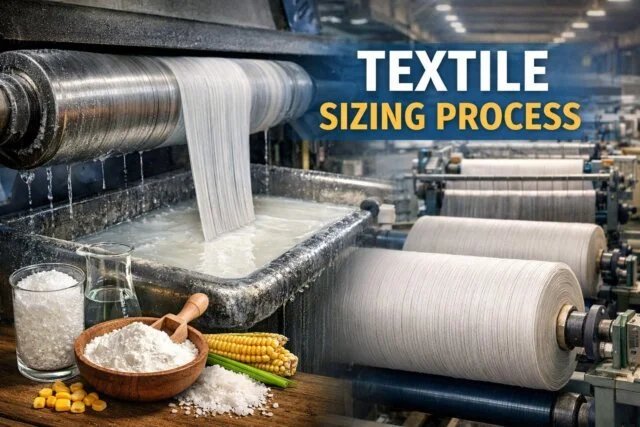
Sizing is one of the most critical preparatory operations in textile manufacturing, particularly in weaving. It plays a decisive role in determining weaving efficiency, fabric quality, loom productivity, and overall manufacturing cost. Despite being a temporary treatment, sizing has a long-lasting influence on yarn behavior during weaving and subsequent processing stages.
This article provides a comprehensive and technically detailed explanation of sizing in textile manufacturing, covering its objectives, working principles, materials used, process steps, machinery, and quality considerations from an industrial perspective.
Introduction to Sizing in Textile Manufacturing
Sizing in textile refers to the application of a protective adhesive coating on warp yarns before weaving. Warp yarns are subjected to continuous friction, tension, bending, and abrasion during weaving. Without adequate protection, yarn breakage becomes frequent, leading to lower loom efficiency and inferior fabric quality.
The sizing process creates a thin film over the yarn surface, binding loose fibers, improving yarn strength, reducing hairiness, and enhancing resistance to mechanical stress. This treatment is mainly applied to spun yarns such as cotton, viscose, and blended yarns, though filament yarns may also be sized under specific conditions.
Objectives of the Sizing Process
The primary goal of the sizing process is to improve warp yarn performance during weaving. However, its objectives extend beyond simple strength enhancement.
Key objectives include:
Increasing tensile strength of warp yarns
Reducing yarn hairiness and lint formation
Improving abrasion resistance
Enhancing yarn smoothness for easy shedding
Reducing end breakage on the loom
Improving weaving efficiency and fabric uniformity
Ensuring consistent yarn behavior throughout the weaving cycle
An effective sizing operation balances strength improvement with flexibility, ensuring the yarn does not become brittle or stiff.
Importance of Sizing in Textile Production
In modern high-speed weaving machines such as air-jet and rapier looms, yarns are subjected to significantly higher mechanical stresses compared to conventional looms. This makes sizing in textile production even more essential.
Without proper sizing:
Warp breakages increase dramatically
Loom stoppages rise, reducing productivity
Fabric defects such as broken ends and streaks appear
Subsequent processes like desizing and dyeing become problematic
Thus, the sizing process in textile manufacturing is not merely a preparatory step but a productivity-enhancing and quality-assuring operation.
Sizing Materials Used in Textiles
Sizing materials, also known as size agents, are selected based on yarn type, fabric end-use, weaving method, and desizing requirements. These materials are broadly classified into natural, modified natural, and synthetic sizes.
Natural Sizing Materials
Starch (maize, potato, tapioca)
Wheat starch
Natural sizes are economical and biodegradable but have limitations such as brittleness and poor flexibility.
Modified Natural Sizes
Oxidized starch
Etherified starch
Enzyme-modified starch
These offer improved film-forming properties, flexibility, and easier desizing.
Synthetic Sizing Materials
Polyvinyl alcohol (PVA)
Polyacrylates
Carboxymethyl cellulose (CMC)
Synthetic sizes provide excellent abrasion resistance and flexibility but are more expensive and pose environmental concerns if not properly recovered.
Additives in Size Paste
To improve performance, several additives are incorporated:
Softeners to improve flexibility
Lubricants to reduce friction
Antistatic agents to control static electricity
Preservatives to prevent microbial growth
Classification of Sizing Based on Yarn Type
Sizing of Cotton Yarns
Cotton yarns require sizing due to their short staple length and high hairiness. Starch-based or blended size recipes are commonly used.
Sizing of Blended Yarns
Blended yarns such as polyester-cotton require careful formulation to balance adhesion and flexibility.
Sizing of Filament Yarns
Filament yarns generally require minimal sizing, mainly to reduce static charge and friction.
Steps Involved in the Sizing Process in Textile Industry
The sizing process in textile production involves several sequential steps, each contributing to the final yarn quality.
1. Preparation of Size Paste
The size paste is prepared by cooking the sizing materials in water at controlled temperature and agitation to ensure uniform viscosity and dispersion.
2. Yarn Sheet Formation
Warp yarns from the warper beam are separated and arranged into a sheet to allow uniform penetration of size liquor.
3. Size Application
The yarn sheet passes through a size box containing the prepared size solution. Proper immersion ensures uniform coating.
4. Squeezing
Excess size liquor is removed using squeezing rollers. This step controls size pick-up percentage and uniformity.
5. Drying
Sized yarns are dried using steam-heated cylinders or hot air chambers to form a continuous protective film.
6. Winding onto Weavers Beam
After drying, the sized yarn sheet is wound onto a weaver’s beam, ready for loom insertion.
Sizing Machinery Used in Industry
Conventional Slasher Sizing Machine
Used for cotton and blended yarns with multiple drying cylinders and size boxes.
Multi-Cylinder Sizing Machine
Provides controlled drying and uniform size distribution.
Single-End Sizing Machine
Used for technical textiles and special yarns requiring precise control.
Modern Automatic Sizing Machines
Equipped with:
Online viscosity control
Automatic moisture regulation
Digital tension control
Energy-efficient drying systems
Key Parameters Affecting Sizing Quality
Several technical parameters determine the success of sizing in textile processing:
Size concentration and viscosity
Size pick-up percentage
Yarn tension during sizing
Drying temperature and duration
Moisture content of sized yarn
Uniformity of size application
Incorrect control of these parameters can lead to brittle yarns, excessive stiffness, poor desizing, and weaving problems.
Advantages of Proper Sizing
Significant reduction in warp breakage
Improved loom efficiency
Higher fabric quality
Better control over weaving defects
Reduced production downtime
Enhanced consistency in large-scale manufacturing
Limitations and Challenges of Sizing
Despite its advantages, the sizing process also presents challenges:
Increased processing cost
Requirement of desizing before dyeing and finishing
Environmental impact of synthetic size agents
Risk of uneven sizing if poorly controlled
Modern textile mills address these challenges through optimized formulations, size recovery systems, and eco-friendly sizing materials.
Desizing: A Necessary Follow-Up Process
Since sizing materials are temporary, they must be removed after weaving. Desizing is essential to ensure proper dye penetration and fabric softness.
Common desizing methods include:
Enzymatic desizing
Oxidative desizing
Acid desizing
Hot water washing
The choice of method depends on the type of size used during the sizing process in textile manufacturing.
Conclusion
Sizing in textile manufacturing is a technically sophisticated and economically vital operation that directly influences weaving performance and fabric quality. A well-designed sizing process enhances yarn strength, reduces breakage, improves loom efficiency, and ensures smooth downstream processing.
With advancements in sizing materials, machinery automation, and sustainability-focused practices, modern sizing operations are becoming more efficient, precise, and environmentally responsible. For textile students, technicians, and industry professionals, understanding the fundamentals and industrial practices of the sizing process in textile production is essential for achieving consistent and high-quality woven fabrics.
Frequently Asked Questions on Sizing in Textile
What is sizing in textile manufacturing?
Sizing in textile manufacturing is a preparatory process in which warp yarns are coated with a size solution to improve their strength, smoothness, and abrasion resistance. This treatment helps yarns withstand mechanical stress during weaving and reduces end breakage on looms.
Why is sizing required before weaving?
Sizing is required before weaving because warp yarns experience continuous friction, tension, and bending during loom operation. The sizing process reduces yarn hairiness, increases tensile strength, and improves resistance to abrasion, resulting in higher loom efficiency and better fabric quality.
What materials are used in the sizing process?
Materials used in the sizing process include natural sizes such as starch, modified starches, and synthetic polymers like polyvinyl alcohol and carboxymethyl cellulose. Additives such as softeners, lubricants, and antistatic agents are also included to enhance yarn flexibility and performance.
How does the sizing process affect fabric quality?
The sizing process directly affects fabric quality by minimizing warp breakages and ensuring uniform yarn behavior during weaving. Proper sizing reduces weaving defects such as broken ends and streaks, leading to smoother fabric surfaces and improved consistency in finished woven fabrics.
What is desizing and why is it necessary?
Desizing is the removal of sizing materials from fabric after weaving. It is necessary because size coatings hinder dye penetration and finishing processes. Effective desizing ensures proper absorbency, uniform coloration, and softness of the fabric during subsequent dyeing and finishing operations.

Meena Ansari is the co-founder and business partner at M/s Tex Aux Chemicals. A passionate writer at heart, she brings a deep curiosity and love for learning to every aspect of the textile industry. With a keen interest in exploring innovations and sharing insights, Meena combines her entrepreneurial experience with a flair for storytelling to educate and inspire readers across the textile community.
- Meena Ansari
- Meena Ansari
- Meena Ansari
- Meena Ansari
- Meena Ansari
- Meena Ansari
- Meena Ansari
- Meena Ansari
- Meena Ansari
- Meena Ansari
- Meena Ansari
- Meena Ansari
- Meena Ansari
- Meena Ansari
- Meena Ansari
- Meena Ansari