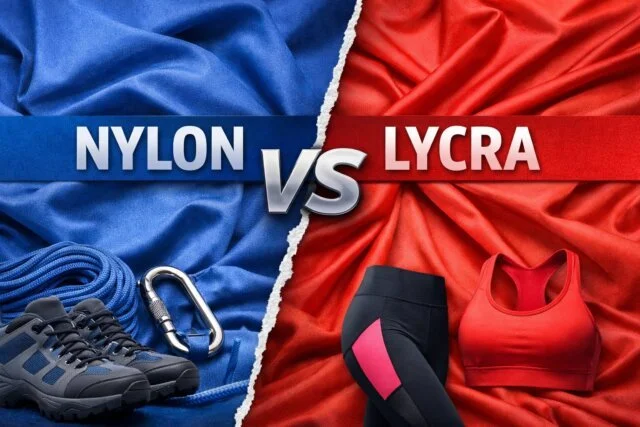
In the modern textile and apparel industry, synthetic fibers play a critical role in delivering comfort, durability, and performance. Among these fibers, Lycra and nylon are two of the most widely used materials, often misunderstood or used interchangeably. While both are synthetic fibers, their chemical structure, functional properties, applications, and performance characteristics differ significantly.
This article presents a detailed and practical comparison of lycra vs nylon, helping readers understand how each fiber behaves, where it performs best, and how to choose the right material for specific end uses.
Understanding Lycra
What Is Lycra?
Lycra is a brand name for elastane, also commonly referred to as spandex. It is a polyurethane-based synthetic fiber known for its exceptional elasticity. Lycra was developed to provide stretch and recovery far superior to natural elastic materials such as rubber.
Lycra fibers can stretch five to eight times their original length and return to their original shape without permanent deformation. Due to this property, Lycra is rarely used alone and is instead blended with other fibers such as cotton, polyester, or nylon.
Key Characteristics of Lycra
Extremely high elasticity and stretch recovery
Lightweight and fine filament structure
Excellent shape retention
Resistant to body oils, perspiration, and lotions
Low moisture absorption
Sensitive to heat and chlorine if not treated
Understanding Nylon
What Is Nylon?
Nylon is a synthetic polyamide fiber, first developed as a silk substitute. It was one of the earliest synthetic fibers and remains widely used due to its strength, abrasion resistance, and durability.
Unlike Lycra, nylon is primarily valued for its structural strength rather than elasticity. It can be produced as filament yarns or staple fibers and is commonly used in textiles that require toughness and longevity.
Key Characteristics of Nylon
High tensile strength
Excellent abrasion resistance
Smooth surface and lustrous appearance
Moderate elasticity but poor recovery compared to Lycra
Low moisture regain
Thermoplastic in nature
Lycra vs Nylon: Fiber Structure Comparison
When comparing lycra vs nylon, the first major distinction lies in their polymer structure.
Lycra is composed of long-chain polyurethane segments that alternate between rigid and flexible regions. This structure allows Lycra fibers to stretch extensively and recover efficiently.
Nylon, on the other hand, has a linear polyamide structure with strong hydrogen bonding. This results in high strength and durability but limits stretch and elastic recovery.
Elasticity and Stretch Performance
Elasticity is the most defining difference in the lycra vs nylon comparison.
Lycra is specifically engineered for extreme stretch and recovery. Fabrics containing even 2–5% Lycra can dramatically improve comfort, fit, and freedom of movement.
Nylon has limited natural stretch. While it can elongate under stress, it does not recover fully once stretched unless combined with Lycra or other elastic fibers.
Conclusion: Lycra is unmatched for stretch, while nylon requires blending to achieve elastic performance.
Strength and Durability
In terms of strength, nylon clearly outperforms Lycra.
Nylon fibers exhibit:
High tensile strength
Resistance to tearing and abrasion
Long service life under mechanical stress
Lycra fibers are relatively delicate and can break down under excessive tension, heat, or chemical exposure. For this reason, Lycra is usually protected within blends rather than exposed on fabric surfaces.
Conclusion: Nylon is superior for durability, while Lycra contributes flexibility rather than strength.
Comfort and Fit
Comfort is a critical consideration in apparel, and this is where the lycra vs nylon debate becomes application-specific.
Lycra enhances:
Body-hugging fit
Freedom of movement
Reduced garment sagging and deformation
Nylon contributes:
Smooth hand feel
Lightweight comfort
Low friction against skin
When combined, nylon provides structural support while Lycra ensures comfort and flexibility, making the blend ideal for activewear and performance clothing.
Moisture Management and Breathability
Both Lycra and nylon are hydrophobic fibers, meaning they absorb very little moisture.
Nylon dries quickly and allows moisture to spread across the fabric surface, improving evaporation when engineered correctly.
Lycra does not significantly contribute to moisture management but does not obstruct it when used in small percentages.
Conclusion: Nylon performs better in moisture management, while Lycra plays a neutral role.
Heat Resistance and Thermal Behavior
In the lycra vs nylon comparison, thermal stability is an important factor in manufacturing and care.
Lycra is sensitive to:
High ironing temperatures
Prolonged heat exposure
Improper tumble drying
Nylon is thermoplastic and can withstand higher temperatures, although excessive heat can cause melting or deformation.
Conclusion: Nylon is more heat-resistant than Lycra.
Chemical and Environmental Resistance
Nylon has excellent resistance to:
Alkalis
Oils and solvents
Mechanical wear
However, it is sensitive to strong acids and prolonged UV exposure.
Lycra is resistant to body oils and sweat but is vulnerable to:
Chlorine
UV radiation
Strong detergents
This difference is especially important in swimwear and sportswear design.
Dyeing and Aesthetic Properties
Nylon has good dye affinity and can be dyed in bright, vibrant colors with excellent colorfastness.
Lycra is usually dyed along with the base fiber in blends. Special dyeing processes are required to avoid fiber damage.
From an aesthetic standpoint, nylon offers:
Smooth surface
High luster or matte finishes
Lycra primarily influences fabric performance rather than appearance.
Applications: Lycra vs Nylon in End Uses
Apparel Applications
Lycra is commonly used in:
Stretch jeans
Leggings and tights
Sportswear
Compression garments
Undergarments
Nylon is widely used in:
Hosiery
Activewear
Jackets and windbreakers
Lingerie
Swimwear
Industrial and Technical Uses
Nylon dominates technical applications such as:
Ropes and cords
Parachutes
Conveyor belts
Automotive textiles
Lycra is rarely used in industrial textiles due to its limited strength.
Cost and Economic Considerations
From a cost perspective, Lycra is generally more expensive per kilogram than nylon due to its complex production process and proprietary technology.
However, Lycra is used in small quantities, so its overall impact on fabric cost is often justified by improved performance and garment value.
Nylon offers a cost-effective solution for strength, durability, and versatility in large-scale production.
Sustainability Considerations
Both fibers are petroleum-based and not biodegradable.
Recent developments include:
Recycled nylon from fishing nets and industrial waste
Bio-based elastane research to reduce Lycra’s environmental footprint
At present, recycled nylon has a more established sustainability pathway than Lycra.
Lycra vs Nylon: Summary Table (Conceptual)
Elasticity: Lycra – Excellent | Nylon – Moderate
Strength: Lycra – Low | Nylon – High
Durability: Lycra – Moderate | Nylon – Excellent
Heat Resistance: Lycra – Low | Nylon – Moderate
Primary Role: Lycra – Stretch | Nylon – Structure
Final Conclusion
The comparison of lycra vs nylon reveals that these fibers are not competitors but complementary materials. Lycra excels in elasticity, comfort, and fit, while nylon provides strength, durability, and surface aesthetics.
In most modern textiles, especially activewear and performance apparel, the best results are achieved by blending nylon with a small percentage of Lycra, combining flexibility with resilience.
Understanding the distinct roles of Lycra and nylon allows designers, manufacturers, and consumers to make informed decisions, ensuring the right fiber choice for every application.
FAQ Section
What is the main difference between Lycra and Nylon?
The main difference between Lycra and nylon lies in elasticity. Lycra is designed for exceptional stretch and recovery, while nylon is valued for strength, durability, and abrasion resistance rather than high elasticity.
Is Lycra stronger than Nylon?
No, nylon is significantly stronger than Lycra. Nylon has high tensile strength and durability, whereas Lycra is comparatively delicate and is mainly used to provide stretch and flexibility in blended fabrics.
Which is better for activewear: Lycra or Nylon?
Both fibers are ideal when used together. Nylon provides strength, smoothness, and durability, while Lycra adds stretch and comfort. Most high-performance activewear uses a nylon-Lycra blend.
Does Nylon stretch like Lycra?
Nylon has limited stretch but lacks the recovery of Lycra. Once stretched, nylon may not fully return to its original shape, which is why Lycra is added to nylon fabrics for elasticity.
Is Lycra or Nylon better for summer clothing?
Nylon is better for summer clothing due to its lightweight nature and quick-drying properties. Lycra does not improve breathability but enhances comfort and fit when blended in small percentages.

Meena Ansari is the co-founder and business partner at M/s Tex Aux Chemicals. A passionate writer at heart, she brings a deep curiosity and love for learning to every aspect of the textile industry. With a keen interest in exploring innovations and sharing insights, Meena combines her entrepreneurial experience with a flair for storytelling to educate and inspire readers across the textile community.
- Meena Ansari
- Meena Ansari
- Meena Ansari
- Meena Ansari
- Meena Ansari
- Meena Ansari
- Meena Ansari
- Meena Ansari
- Meena Ansari
- Meena Ansari
- Meena Ansari
- Meena Ansari
- Meena Ansari
- Meena Ansari
- Meena Ansari
- Meena Ansari